
Signal-Based Deal Forecasting
AI-Driven Opportunity Risk Scoring for Salesforce
Know Which Deals Are at Risk — Before It Is Too Late to Act.
Sales forecasting in most organisations relies on what reps choose to report. Stages are updated manually, forecast categories reflect optimism as much as reality, and at-risk deals surface during the weekly pipeline call — when there is often little time left to recover them.
Signal-Based Deal Forecasting changes the model. Every week, the system independently reviews every open Opportunity in your Salesforce pipeline — reading the actual signals of engagement, momentum, and deal health — and surfaces a clear, AI-generated risk assessment with specific reasons and concrete next steps, automatically assigned to the deal owner.
See It In Action
Watch how Signal-Based Deal Forecasting independently evaluates every open Opportunity against ten deal health signals and produces a risk assessment with specific reasons — automatically, every week.
Signal-Based Deal Forecasting — Demo
Why Pipeline Reviews Miss At-Risk Deals
Traditional Salesforce forecasting is built on rep declarations — stage, forecast category, and close date entered by the person who owns the deal. In practice, this creates structural blind spots for every sales leader:
How Signal-Based Deal Forecasting Works
Rather than relying on what reps report, the solution reads the signals already captured in Salesforce — activity recency, email engagement, stage velocity, deal size stability, stakeholder coverage, and time pressure — and submits them to an AI model for an independent assessment of each deal.
The system runs automatically every week across all open Opportunities and completes four steps:
Step 1 — Signals Assembled from Salesforce Activity Data
For every open Opportunity, the system gathers data from across Salesforce — recent and upcoming tasks, events, emails, stage change history, and deal size movement — and computes a set of deal health signals that reflect what is actually happening on the deal.
Step 2 — AI Analyses Each Deal Independently
The assembled signals are sent to an AI model that evaluates each Opportunity against stage-appropriate expectations — what normal engagement looks like at prospecting versus negotiation — and produces a structured risk assessment grounded in the actual signal data.
Step 3 — Risk Scores Written Back to Salesforce
The AI output — risk level, confidence score, specific risk reasons, and a recommended action — is written directly to the Opportunity record, making it available in dashboards, list views, and reports without any manual entry.
Step 4 — Action Tasks Created on the Deal
The system automatically creates 1 to 3 prioritised follow-up tasks on each Opportunity, assigned to the deal owner, with a specific subject and explanation tied to the signals that triggered them. Stale tasks from the previous run are replaced with the latest recommendations on every cycle.
Functional Flow Diagram
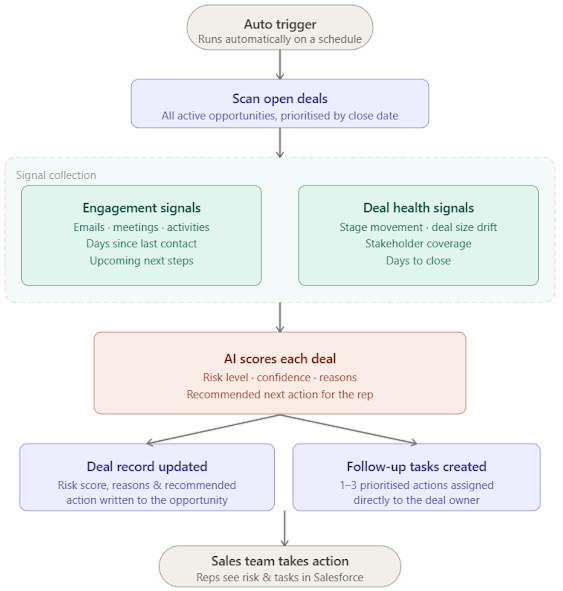
Nightly flow: from the automatic trigger and signal collection through AI scoring to the deal updates and follow-up tasks the sales team acts on.
Technical Solution Overview
Signal-Based Deal Forecasting is an automated AI scoring solution built natively on the Salesforce platform. The system runs end-to-end on a nightly schedule — independently assembling deal signals, submitting them to an AI model for risk assessment, writing scores back to Opportunity records, and creating prioritised action tasks for deal owners — without any manual initiation.
Each capability is delivered through Salesforce technologies as follows:
Architecture principle: Deterministic Apex automation guarantees accuracy and consistency for signal computation, score persistence, and task lifecycle management — anything involving deal data and CRM write-back. Generative prompt templates handle risk language, reason generation, and action recommendations. Together, the system is fully agentic in its operation: running on a fixed schedule across the entire pipeline, assessing every deal independently, and surfacing deal-specific guidance to reps each morning — without waiting to be asked.
Key Features
Nightly Automated Scoring — No Manual Initiation Required
The scoring pipeline runs automatically on a nightly schedule across every open Opportunity in the pipeline. There is no report to run, no trigger to click, and no process to initiate. Every deal is assessed independently and consistently on every cycle.
Multi-Signal Deal Context — Ten Dimensions of Deal Health
The system evaluates each deal across ten distinct signals drawn from real Salesforce activity data. Together these signals give the AI a comprehensive picture of engagement quality, momentum, stakeholder coverage, and time pressure for every Opportunity.
AI Risk Assessment — Scores Grounded in Signal Data
The AI evaluates each Opportunity against stage-appropriate benchmarks and returns a structured risk assessment with a clear rating, a confidence score, and specific reasons that reference the actual signal values — not generic observations.
Automated Deal-Specific Task Creation — Action Items Without Manager Intervention
For every scored Opportunity, the AI generates 1 to 3 follow-up tasks that are automatically created in Salesforce and assigned to the deal owner. Each task is grounded in a specific signal, contains a clear subject and explanation, and is due within a set number of days — giving reps targeted guidance without waiting for a coaching conversation.
Solution Tech Highlights
The nightly pipeline runs entirely on standard Salesforce scheduling and data infrastructure, with a single third-party AI service called for the deal-level risk assessment. No middleware, iPaaS, or separate application is required.